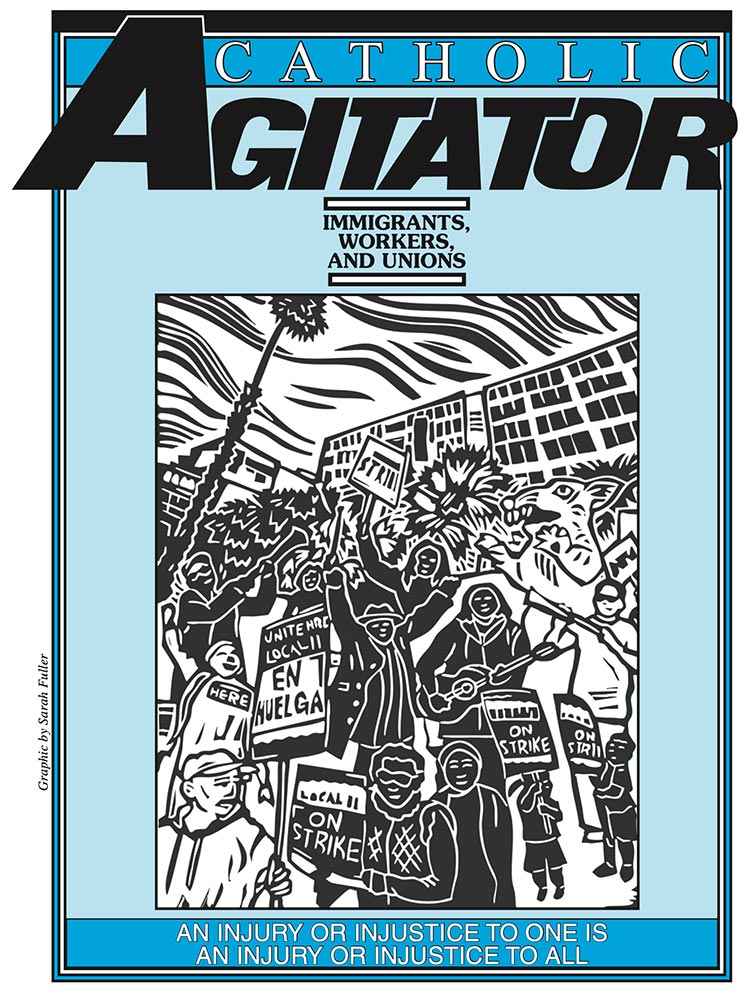
BY DAYQUAN MOELLER
In June, I was in the passenger seat of my sister’s car on the way to lunch together. With a little time to spend, I opened a three-ring binder and began highlighting names in a spreadsheet. A confused look came upon her face.
“What’s that?” she asked. “Work.” I replied. She laughed. At the time, I was less than two months into my first campaign as an organizer with my union, UNITE HERE! Local 11, and until that very moment, I am pretty sure my sister thought being on staff with the union basically meant I was a paid protestor. It never crossed her mind that I would also make spreadsheets, answer emails, and do other “real job” activities.
Of course there are days where I basically am a paid protestor—the reality of living in a world with too many disrespected workers. Picket lines, rallies, and marches are an almost weekly occurrence, and it is always a pleasure to take the streets and lead a crowd with songs and chants. But those moments do not materialize out of thin air.
Behind every “Norma Rae moment” is a difficult conversation—a last- minute phone call, or a tough house visit in which a worker, politician, or community member must be remind- ed of the importance of their presence. Much like the hidden labor it takes to produce the consumer goods we enjoy, the time, care, and emotion- al labor it takes to plan and execute an action is equally elusive to those who have not done it themselves. And to put it bluntly, in my (admittedly short) time as a paid organizer, I have quickly learned that this work is never easy, and it is not always fun. So why do I do it?
I was born a union baby, but I have never really considered myself as such until sitting down to write this article. In fact, I had no idea that my parents were union members until my first semester of college when my dad told me to apply for a scholarship offered by his union, the International Brotherhood of Teamsters.
My earliest memories of my father are of being woken up at 4am by the sound of his steel toe work boots walking through the dark halls of our home. This ritual continued from kindergarten through college, but I never once resented being woken up hours before sunrise, because I knew why my dad was up. He was up at 4am to go to a Ralph’s warehouse in south Compton. He was up at 4am to sup- port me, and the rest of our family.
And unlike some of my wealthier (and not-so-coincidentally, whiter) classmates, I did not have the luxury of a stay-at-home mom. My mother would also wake before dawn to start a shift as an elementary school cafeteria worker, where she was represented by the California School Employees Association.
Frequently, she would express interest in getting more involved with the P.T.A., but life had other plans. In 2013, my mother picked up a second job working the concessions stands on game days at Dodger Stadium, be- coming a member of UNITE HERE! Local 11. My father would do the same the following year.
I am somewhat embarrassed that for most of my life both of my parents worked not one but two union jobs. And yet I had no real understanding of what unions were until adulthood. In my de-fense, neither of my parents were ever forthcoming about their involvement with their respective unions. In fact, they never mentioned unions at all.
But while, to this day, my moth- er can tell you very little about her union, she can tell you all about seniority. I remember her posting a printed schedule from Dodger Stadium on our fridge, showing how her seniority was being honored.
And from the seventh grade on- ward, I watched as countless family members followed my mom’s foot- steps by quitting whatever dead-end side hustle they had to go work at Dodger Stadium. It was during this time I learned that not all jobs were created equal. Even within the same food industry, there were good jobs and shit jobs. And my parents teaching me the difference between good jobs and shit jobs did far more to radicalize me than anything Marx, Lenin, or Mao ever wrote.
It certainly raised my expectations for any job I acquired as an adult. So much so, that when I obtained my first shit job working at a bar in Santa Monica, I organized it. I could not do it alone, of course. I worked very closely with one of my coworkers (a dear friend whose good word to the manager actually got me the job in the first place) to have deep, vulnerable conversations with nearly everyone else in the bar.
It was not hard to get our coworkers to agree that having to do the work of three or more for minimum wage and no benefits was not the kind of job we needed to survive in L.A. What was hard was convincing our coworkers that it was actually possible to make things better.
On the nearly two-hour train ride from downtown to the Santa Monica Pier, I would read Capitalist Realism by Mark Fisher, in which he describes “capitalist realism” as a cultural phenomenon where “it is easier to imagine an end to the world than an end to capitalism.”
While trying to organize my workplace, I was coming up against a kind of “workplace realism,” in which my coworkers could sooner believe the Santa Monica Pier would be swallowed up by the ocean long before we would earn a living wage. Furthermore, a fear of retaliation from managers, ostracization from anti-union coworkers, and the humiliation of failure kept many from even imagining a better world.
One of the ways I was able to cut through this fear was by, for the first time in my life, publicly sharing what it meant for me to be born into a union family. I talked about the stability of seniority, healthcare, and a pension, about how as an adult living on my own for the first time, I wanted those things for myself. This persistence paid off, and after many tough late night conversations, a majority of my coworkers signed union cards.
Too many of us have learned to dampen our imagination towards the things we deserve. We have been trained to see ourselves as powerless, caught in currents we could not possibly change. But I have seen a different world and I know better is possible, just waiting for us to seize it.
And I want that so badly for all of us; so many of us want that for all of us. Whether you believe it yet or not, know we are here and we do not plan on going anywhere but a next picket line or house meeting. You just need to decide when you will risk the shit you have been conditioned to accept for the dignity and security you deserve.
Dayquan Moeller is an organizer with Unite HERE! Local 11.
CATHOLIC AGITATOR: WITH UNION IN MY BLOOD
BY DAYQUAN MOELLER
In June, I was in the passenger seat of my sister’s car on the way to lunch together. With a little time to spend, I opened a three-ring binder and began highlighting names in a spreadsheet. A confused look came upon her face.
“What’s that?” she asked. “Work.” I replied. She laughed. At the time, I was less than two months into my first campaign as an organizer with my union, UNITE HERE! Local 11, and until that very moment, I am pretty sure my sister thought being on staff with the union basically meant I was a paid protestor. It never crossed her mind that I would also make spreadsheets, answer emails, and do other “real job” activities.
Of course there are days where I basically am a paid protestor—the reality of living in a world with too many disrespected workers. Picket lines, rallies, and marches are an almost weekly occurrence, and it is always a pleasure to take the streets and lead a crowd with songs and chants. But those moments do not materialize out of thin air.
Behind every “Norma Rae moment” is a difficult conversation—a last- minute phone call, or a tough house visit in which a worker, politician, or community member must be remind- ed of the importance of their presence. Much like the hidden labor it takes to produce the consumer goods we enjoy, the time, care, and emotion- al labor it takes to plan and execute an action is equally elusive to those who have not done it themselves. And to put it bluntly, in my (admittedly short) time as a paid organizer, I have quickly learned that this work is never easy, and it is not always fun. So why do I do it?
I was born a union baby, but I have never really considered myself as such until sitting down to write this article. In fact, I had no idea that my parents were union members until my first semester of college when my dad told me to apply for a scholarship offered by his union, the International Brotherhood of Teamsters.
My earliest memories of my father are of being woken up at 4am by the sound of his steel toe work boots walking through the dark halls of our home. This ritual continued from kindergarten through college, but I never once resented being woken up hours before sunrise, because I knew why my dad was up. He was up at 4am to go to a Ralph’s warehouse in south Compton. He was up at 4am to sup- port me, and the rest of our family.
And unlike some of my wealthier (and not-so-coincidentally, whiter) classmates, I did not have the luxury of a stay-at-home mom. My mother would also wake before dawn to start a shift as an elementary school cafeteria worker, where she was represented by the California School Employees Association.
Frequently, she would express interest in getting more involved with the P.T.A., but life had other plans. In 2013, my mother picked up a second job working the concessions stands on game days at Dodger Stadium, be- coming a member of UNITE HERE! Local 11. My father would do the same the following year.
I am somewhat embarrassed that for most of my life both of my parents worked not one but two union jobs. And yet I had no real understanding of what unions were until adulthood. In my de-fense, neither of my parents were ever forthcoming about their involvement with their respective unions. In fact, they never mentioned unions at all.
But while, to this day, my moth- er can tell you very little about her union, she can tell you all about seniority. I remember her posting a printed schedule from Dodger Stadium on our fridge, showing how her seniority was being honored.
And from the seventh grade on- ward, I watched as countless family members followed my mom’s foot- steps by quitting whatever dead-end side hustle they had to go work at Dodger Stadium. It was during this time I learned that not all jobs were created equal. Even within the same food industry, there were good jobs and shit jobs. And my parents teaching me the difference between good jobs and shit jobs did far more to radicalize me than anything Marx, Lenin, or Mao ever wrote.
It certainly raised my expectations for any job I acquired as an adult. So much so, that when I obtained my first shit job working at a bar in Santa Monica, I organized it. I could not do it alone, of course. I worked very closely with one of my coworkers (a dear friend whose good word to the manager actually got me the job in the first place) to have deep, vulnerable conversations with nearly everyone else in the bar.
It was not hard to get our coworkers to agree that having to do the work of three or more for minimum wage and no benefits was not the kind of job we needed to survive in L.A. What was hard was convincing our coworkers that it was actually possible to make things better.
On the nearly two-hour train ride from downtown to the Santa Monica Pier, I would read Capitalist Realism by Mark Fisher, in which he describes “capitalist realism” as a cultural phenomenon where “it is easier to imagine an end to the world than an end to capitalism.”
While trying to organize my workplace, I was coming up against a kind of “workplace realism,” in which my coworkers could sooner believe the Santa Monica Pier would be swallowed up by the ocean long before we would earn a living wage. Furthermore, a fear of retaliation from managers, ostracization from anti-union coworkers, and the humiliation of failure kept many from even imagining a better world.
One of the ways I was able to cut through this fear was by, for the first time in my life, publicly sharing what it meant for me to be born into a union family. I talked about the stability of seniority, healthcare, and a pension, about how as an adult living on my own for the first time, I wanted those things for myself. This persistence paid off, and after many tough late night conversations, a majority of my coworkers signed union cards.
Too many of us have learned to dampen our imagination towards the things we deserve. We have been trained to see ourselves as powerless, caught in currents we could not possibly change. But I have seen a different world and I know better is possible, just waiting for us to seize it.
And I want that so badly for all of us; so many of us want that for all of us. Whether you believe it yet or not, know we are here and we do not plan on going anywhere but a next picket line or house meeting. You just need to decide when you will risk the shit you have been conditioned to accept for the dignity and security you deserve.
Dayquan Moeller is an organizer with Unite HERE! Local 11.
TRAVEL AGENT CENTRAL: U.S. Hotel Workers are Once Again on Strike
In the shadow of the Hollywood Bowl, hotel workers at the Hilton Garden Inn hotel in Hollywood started a picket line at 6 a.m. local time today. The 160-room property, owned by RLJ Lodging Trust and operated by Aimbridge Hospitality, expected high occupancy this weekend for one of the last Hollywood Bowl concerts of the year.
In Philadelphia, workers at the Wyndham Philadelphia Historic District hotel—also owned by RLJ Lodging Trust and operated by Aimbridge—walked off the job earlier today, just ahead of the Thanksgiving travel season.
Stop Firing Vets!
We were proud to join veterans, families, and allies gathered and traveled together to Tucson, Sierra Vista, and Phoenix Arizona to advocate for veterans as cuts are being made to the VA and essential services they rely on. Federal layoffs have hit veterans especially hard, threatening livelihoods, stability, and the dignity of service. We’re calling for policies that protect working people, not punish them.
Workers at Aimbridge-operated hotels in Los Angeles and Philadelphia strike simultaneously
In Philadelphia, workers at the Wyndham Historic District hotel—also owned by RLJ Lodging Trust and operated by Aimbridge—walked off the job earlier today, just ahead of the Thanksgiving travel season.
Workers both hotels walked off the job in effort to win wages and benefits that enable them to afford to raise families in the cities where they work
Workers at Aimbridge-operated hotels in Los Angeles and Philadelphia strike during event-filled weekend, UNITE HERE reports
Workers at hotels owned by RLJ Lodging Trust on both coasts walk off the job in effort to win wages and benefits that enable them to afford to raise families in the cities where they work
CONTACT: Rachel Sulkes | [email protected] | 602-327-4084
PHOTOS AVAILABLE; CLICK HERE
LOS ANGELES: In the shadow of the Hollywood Bowl, hotel workers at the Hilton Garden Inn hotel in Hollywood started a picket line at 6 AM local time today.
The 160-room hotel, owned by RLJ Lodging Trust and operated by Aimbridge Hospitality, expected high occupancy this weekend for one of the last Hollywood Bowl concerts of the year.
In Philadelphia, workers at the Wyndham Historic District hotel—also owned by RLJ Lodging Trust and operated by Aimbridge—walked off the job earlier today, just ahead of the Thanksgiving travel season.
“Whether we strike is up to the employers and how willing they are to pay us fairly for the work we do,” said Maria Christina Velasquez, a shop steward with UNITE HERE Local 11 and laundry attendant at the Hilton Garden Inn Hollywood since 2019. “We’re ready for anything.”
“Hotel workers like me go on strike to win raises that keep up with the rising cost of living, pensions, high quality union healthcare, and safe workloads,” said Brent Allen, a restaurant server and member of UNITE HERE Local 274 at the Wyndham Historic District since 2023. “We’re going to welcome millions of visitors to Philly in 2026, but most of us can’t pay our basic bills. We deserve to be able to live dignified lives but that can only happen if the hotel owner and operator pay us what we deserve.”
RLJ Lodging Trust (NYSE: RLJ) owns a portfolio of nearly 100 hotels across 23 states and the District of Columbia. The company just this week announced a year-over-year drop in both revenue and net income. According to campaign filings, between July and September of this year, RLJ Lodging Trust contributed $25,000 to the effort to defeat a $30 minimum wage for hospitality workers that the Los Angeles City Council passed in May.
Aimbridge hospitality operates hotels across the world under known brands like Hilton, Hyatt, and Windham. Aimbridge-operated properties were among the last to settle during the 2023–2024 Southern California Hotel Strike, the largest hotel strike in modern U.S. history.
# # #
UNITE HERE Local 11 is more than 32,000 hospitality workers in Southern California and Arizona who work in hotels, restaurants, universities, convention centers, and airports.
UNITE HERE LOCAL 274 is 4,000 private-sector hotel and food service workers at stadiums, universities, cafeterias, and hotels throughout the Philadelphia region.
Both are affiliates of UNITE HERE, a labor union representing 300,000 workers in gaming, hotel, and food service industries in North America.
PHOTOS
Los Angeles
Philadelphia
Tucson City Council Victory!
Congratulations to reelected and newly elected Tucson City Council members Kevin Dahl, Selina Barajas, and Miranda Schubert on their victories!
Tell Atlantic Street Capital to Bring Back Airport Workers
CALIFORNIA VOTE YES ON PROP 50!
California voters overwhelmingly passed Prop 50 to counter Trump and Texas’ election rigging and ensure fair representation for California. This is a tremendous win for California and the rest of our country. ¡Sí se pudo!
Local 11 Endorses a Labor Champion for the Environment: Dr. Rocio Rivas for LAUSD Board District 2
Dr. Rivas chairs the Greening Schools and Climate Resilience Committee of the Los Angeles Unified Board of Education, a group that researches and proposes what the District needs to create sustainable, healthy, resilient, and equitable learning environments.
What the Committee is doing:
Click here to learn more about Dr. Rocio Rivas and the LAUSD Greening Schools and Climate Resilience Committee
Dodger Workers Win Big During World Series!!
We’d like to take a moment to appreciate the workers who create the Dodger Stadium experience! Workers at Dodgers Stadium are the ultimate fans: when games go extra innings, so do workers.
In 2022, Dodgers Stadium workers signed a fantastic union contract with life-changing wages and benefits. And they’re about to enter negotiations for their next contract!
Click here to learn more about what they won in their contract, and why we are Stronger with Local 11!